By
By Compliance Mapping for Mission-Ready Cloud Architecture: An ATO Reference for Defense Program Offices
CMMC Phase 2 enforcement lands November 2026, and fewer than 100 C3PAOs are covering roughly 118,000 organizations that need Level 2 certification. This article maps mission-ready cloud architecture against NIST 800-53, RMF, and CMMC 2.0 control by control, giving PMOs and ISSOs the documentation an Authorizing Official can actually defend.
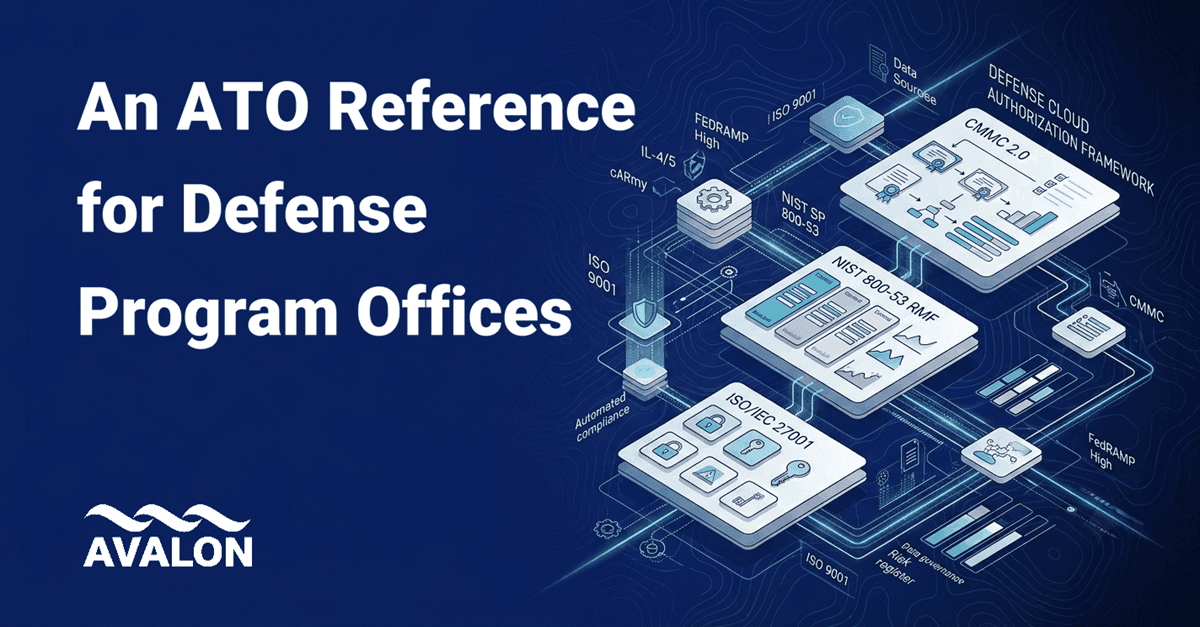
Program Management Offices, Authorizing Officials, and Information System Security Officers evaluating cloud architecture for defense programs need more than a vendor's claim of compliance. They need a control mapping precise enough to survive a Section M evaluation, an RMF assessment, and a CMMC C3PAO review without rework. This article maps a mission-ready cloud architecture against the specific frameworks governing defense cloud authorization and outlines the compliance evidence it produces for ongoing ATO maintenance.
The Compliance Baseline: ISO, NIST, and CMMC Together
Three frameworks govern this architecture's authorization posture, and understanding how they interact is a prerequisite to structuring a defensible ATO package.
ISO 9001:2015 governs the quality management system behind the architecture's delivery. Clause 4 through Clause 10 alignment is not abstract: architecture design incorporates mission context and CONOPS under Clause 4, CI/CD pipelines and change control satisfy the risk-based planning requirements of Clause 6, and telemetry dashboards provide the performance evaluation evidence Clause 9 requires. For a PMO, this maps directly to CPARS documentation and past performance evaluation criteria.
ISO/IEC 27001:2022 governs information security management. Annex A Technological Controls, encryption at rest and in transit, SIEM integration, and secure API design, are enforced through STIGs and SCAP baselines and mapped to classified or Impact Level boundary enforcement under CNSSI 1253.
NIST SP 800-53 Rev. 5 and the Risk Management Framework provide the control baseline that FedRAMP High and DoD IL-4/5 authorizations are built against. The architecture maps its capabilities to all six RMF steps, not just the technical controls most vendors highlight.
RMF Step-by-Step Control Mapping
| RMF Step | Architecture Capability | Example Controls |
|---|---|---|
| 1. Categorize System | Impact level assessment (IL2 through IL6) and mission impact modeling | RA-1, PL-2 |
| 2. Select Controls | Tailored baselines for FedRAMP High and DISA SRG IL4/5 | AC-2, SC-12, IA-5 |
| 3. Implement Controls | Infrastructure as Code templates and DevSecOps pipelines enforce controls consistently at deployment time | CM-2, SI-2, AU-6 |
| 4. Assess Controls | Automated assessment scripts and CSP attestations, reducing manual evidence-gathering | CA-2, CA-7 |
| 5. Authorize System | ATO and cATO evidence packages generated from live system state | AR-5, RA-5 |
| 6. Monitor Controls | Continuous monitoring through telemetry dashboards feeding ConMon reporting | IR-5, SC-38 |
The architecture's value to an ISSO is concentrated in Steps 3, 4, and 6. Control implementation through version-controlled IaC means every configuration change is attributable and reviewable, closing the gap between what an SSP claims and what the running environment actually enforces. Read-only forensic audit methodology (opens in a new tab) built for a different Avalon service demonstrates the same principle: continuous, timestamped evidence replaces the periodic snapshot most legacy ConMon processes still rely on.
CMMC 2.0: What This Architecture Does and Does Not Solve
CMMC 2.0 became a condition of contract award for applicable DoD solicitations on November 10, 2025, requiring Level 2 certification, full implementation of the 110 controls in NIST SP 800-171 Rev. 2, and third-party assessment by a C3PAO for any contractor handling Controlled Unclassified Information.
The architecture's built-in compliance mapping and control inheritance from FedRAMP High and Platform One, Cloud One, and cArmy hosting environments reduce the unique accreditation burden a program office carries into a C3PAO assessment, the same category of avoidable cost documented in what legacy infrastructure actually costs a program budget (opens in a new tab) when compliance gaps go unaddressed. But architecture alone does not certify an organization. Readiness assessments, documentation review, and personnel-level controls under NIST SP 800-171 Rev. 2 sections outside the technical boundary remain the program office's responsibility.
The urgency here is structural, not rhetorical. Phase 2 enforcement, requiring C3PAO-certified Level 2 status rather than self-assessment, begins November 10, 2026 (opens in a new tab), and assessor capacity is already constrained: an estimated 100 authorized C3PAOs currently serve roughly 118,000 organizations (opens in a new tab) that will need Level 2 certification, with many assessors already booked into next year. A PMO that has not scheduled a C3PAO assessment by the time this deadline arrives is not just facing a documentation gap. It is facing a scheduling gap with no available capacity to close it quickly.
VAULTIS Data Governance as ATO Evidence
Beyond technical controls, this architecture produces continuous evidence against a VAULTIS-aligned data governance scorecard: catalog coverage at 90% or above of production tables, tag accuracy at 98% or above, lineage latency under 5 seconds, and a 100% OPA policy-test pass rate per merge. These KPIs are reported quarterly to the governance board and archived as part of the ongoing authorization record.
For an Authorizing Official, this converts data governance from a narrative claim in the SSP into a quarterly, evidence-backed scorecard. That distinction matters most in a cATO context, where continuous evidence is the authorization mechanism itself, not a periodic supplement to it.
The Risk Register as Authorization Support
A formal risk register covering seven risks, from cloud-vendor lock-in to a DevSecOps skills gap, carries a funded mitigation budget of $0.9 million and a five-day schedule buffer (opens in a new tab). Every risk resolves to a residual rating of Low or Medium. For an AO evaluating whether to authorize a system, a funded, documented risk register with no open Medium-High or High residuals is materially different from a proposal that identifies risk without pricing the mitigation.
ISO Alignment as a Cross-Framework Efficiency
Program offices juggling parallel audit obligations rarely have the bandwidth to run separate evidence-gathering exercises for every framework a contract references. This architecture's ISO 9001:2015 and ISO/IEC 27001:2022 alignment is structured to reduce that duplication rather than add another audit lane. Dashboards preconfigured against ISO 9001 Clause 9.1 performance evaluation and ISO 27001 Annex A.12 operations security give a compliance team a single evidence source that satisfies both an ISO surveillance audit and the CPARS quality documentation a contracting officer expects at task order close-out.
This matters most for ISSOs managing a mixed portfolio of commercial-standard and federal-specific obligations. A crosswalk between ISO control language and NIST SP 800-53 control families reduces the number of times the same underlying evidence, an access log, a change record, a vulnerability scan result, has to be reformatted and resubmitted to satisfy a different auditor's terminology. Reciprocity across DCSA and DISA audit cycles depends on exactly this kind of shared control mapping.
What This Architecture Delivers for the Authorization Package
The compliance mapping documentation, control inheritance evidence, and deployment playbooks this architecture produces are built to support Section L and Section M compliance matrices directly. For primes, this shortens the technical volume development cycle. For subcontractors and teaming partners, TRL 8-9 status and ISO 9001/27001 alignment provide a documented technical maturity baseline that satisfies past performance criteria without requiring the subcontractor to build an independent compliance record from scratch.
Program offices structuring an acquisition around this architecture can engage through GSA MAS, OASIS and OASIS+, ASTRO, SEWP V, or Alliant 2 and other GWACs, with modular work packages compatible with OTA and IDIQ contracting mechanisms that support phased authorization rather than a single all-or-nothing ATO event.
Program offices approaching a CMMC C3PAO assessment, or scoping ATO strategy for a new cloud-native program, should engage now to align the compliance mapping against their current System Security Plan before the Phase 2 enforcement window closes. Phase I Planning and Readiness, scoped over 30 to 60 days, is where this alignment work belongs: requirements mapping, ATO strategy planning, and control inheritance documentation are produced before a pilot deployment commits the program to a specific technical path.
THE 2026 DELTA
Three regulatory developments since January 2026 change the compliance posture PMOs and ISSOs must document.
The GSA CUI Guide, effective January 5, 2026, designates nine Showstopper Controls, including Multi-Factor Authentication, Boundary Protection, and Cryptographic Integrity, as mandatory conditions for contract performance on any CUI-handling effort. Self-attestation no longer satisfies this requirement. Authorization packages built on vendor self-attestation for these controls need to be revisited with third-party verification evidence before the next review cycle.
NIST SP 800-171 Rev 3 introduces Organization-Defined Parameters requiring programs to define, document, and enforce organization-specific threshold values rather than relying on the generic language this architecture's underlying whitepaper cites under Rev 2. Program offices should treat an ODP scoping exercise as a near-term priority rather than waiting for a solicitation to require it explicitly.
DoD's own Zero Trust mandate compounds this timeline. Target Level Zero Trust, covering 91 of 152 defined capability activities, is due by the end of fiscal year 2027. An ISSO who can show continuous monitoring evidence tied to specific ODP values and Zero Trust activities is positioned for reciprocity across future authorizations. One who cannot is rebuilding the authorization case from scratch at every renewal.